
Learn Problem Definition in C Programming with definition, steps, algorithm, flowchart, examples, C program, MCQs, FAQs, and interview questions for beginners.
Problem Definition in C Programming
Introduction
Every computer program is developed to solve a specific problem. Before writing any code, a programmer must clearly understand what problem needs to be solved, what input is required, what output is expected, and what constraints must be considered. This initial stage is known as Problem Definition.
Problem Definition is the first and one of the most important steps in the Program Development Life Cycle (PDLC). A well-defined problem helps programmers design efficient algorithms, write error-free code, and develop reliable software.
What is Problem Definition?
Problem Definition is the process of identifying, understanding, and clearly specifying a problem before developing a computer program.
It defines the objective of the program, required inputs, expected outputs, processing logic, and constraints.
Definition
“Problem Definition is the process of identifying, analyzing, and clearly describing a problem along with its inputs, outputs, processing requirements, and constraints before developing a computer program.”
Why is Problem Definition Important?
A properly defined problem provides a clear direction for program development and reduces errors during coding.
Importance
- Clearly identifies the objective of the program.
- Helps in selecting the most appropriate solution.
- Reduces programming errors.
- Saves development time.
- Improves program efficiency.
- Makes testing and debugging easier.
- Produces reliable software.
| Without Problem Definition | With Problem Definition |
| Coding starts immediately | Planning starts first |
| More logical errors | Fewer logical errors |
| Difficult debugging | Easier debugging |
| Time consuming | Efficient development |
Real Classroom Example
During my 15+ years of teaching experience, I have observed that many first-year BCA students begin writing C programs immediately after reading a problem statement. They often skip the important step of identifying the required inputs, expected outputs, and processing logic. As a result, they face logical errors, incorrect program design, and difficulties during debugging.
For example, when students are asked to write a C program to calculate the area of a circle, many directly start coding without first defining the problem. A better approach is to identify:
- Input: Radius of the circle
- Processing: Area = π × Radius × Radius
- Output: Area of the circle
This simple practice helps students develop a clear understanding of the problem before writing the algorithm or C program, leading to more accurate and efficient solutions.
Objectives of Problem Definition
The main objectives are:
- Understand the exact problem.
- Identify required input data.
- Determine the expected output.
- Understand processing requirements.
- Identify limitations and constraints.
- Prepare for algorithm and flowchart design.
Components of Problem Definition
A complete problem definition generally includes the following components:
| Component | Description |
| Problem Statement | Description of the problem to be solved |
| Input | Data required by the program |
| Output | Expected result after processing |
| Processing | Logical operations performed on the input |
| Constraints | Limitations such as memory, time, or data range |
| Assumptions | Conditions assumed while solving the problem |
Steps in Problem Solving
Step 1: Understanding the Problem
The programmer carefully studies the problem to understand its purpose and requirements.
Example
Find the area of a circle.
Input: Radius
Output: Area
Step 2: Problem Analysis
The problem is analyzed to determine:
- Required inputs
- Expected outputs
- Formula or logic
- Constraints
Step 3: Algorithm Design
An algorithm is a step-by-step procedure for solving a problem.
Algorithm
- Start
- Read Radius
- Calculate Area = π × Radius × Radius
- Display Area
- Stop
Step 4: Flowchart Design
A flowchart provides a graphical representation of the algorithm.
Flow
Start
↓
Input Radius
↓
Calculate Area
↓
Display Area
↓
Stop
Step 5: Coding
The algorithm is converted into a programming language such as C.
#include<stdio.h>
int main()
{
float radius, area;
printf(“Enter Radius: “);
scanf(“%f”,&radius);
area = 3.14 * radius * radius;
printf(“Area = %.2f”,area);
return 0;
}
Step 6: Testing and Debugging
The program is executed using different input values to verify correctness.
If errors are found, they are corrected before final implementation.
Complete Example: Calculate Simple Interest
Example: Calculate Simple Interest Using C Programming
To understand the concept of Problem Definition, let us consider a real programming example.
Problem Statement
Write a C program to calculate the Simple Interest (SI) when the Principal Amount (P), Rate of Interest (R), and Time (T) are given.
Step 1: Problem Definition
The programmer first identifies the requirements of the problem before writing the program.
| Component | Description |
| Problem | Calculate Simple Interest |
| Input | Principal (P), Rate (R), Time (T) |
| Processing | SI = (P × R × T) / 100 |
| Output | Simple Interest |
Step 2: Input
The user enters the following values:
- Principal Amount (P)
- Rate of Interest (R)
- Time (T)
Example Input
Principal = 10000
Rate = 8%
Time = 2 Years
Step 3: Processing
The computer processes the given input using the formula:
Formula
Simple Interest=(P×R×T)/100
Step 4: Output
Simple Interest = ₹1600
Algorithm
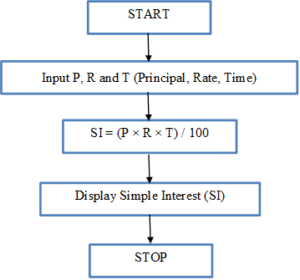
Algorithm to Calculate Simple Interest
- Start
- Read Principal (P), Rate (R), and Time (T)
- Calculate SI = (P × R × T) / 100
- Display Simple Interest
- Stop
Flowchart:
IPO Chart (Input – Process – Output)
| Input | Process | Output |
| Principal (P) | Apply Formula | Simple Interest |
| Rate (R) | SI = (P × R × T) / 100 | ₹1600 |
| Time (T) | Calculate SI | Display SI |
C Program
#include<stdio.h>
int main()
{
float p, r, t, si;
printf(“Enter Principal Amount: “);
scanf(“%f”,&p);
printf(“Enter Rate of Interest: “);
scanf(“%f”,&r);
printf(“Enter Time (Years): “);
scanf(“%f”,&t);
si = (p * r * t) / 100;
printf(“\nSimple Interest = %.2f”, si);
return 0;
}
Sample Output
Enter Principal Amount: 10000 Enter Rate of Interest: 8
Enter Time (Years): 2
Simple Interest = 1600.00
Explanation
In this example, the programmer first defines the problem, identifies the input, processing, and output, and then develops an algorithm, flowchart, and finally the C program. This systematic approach minimizes logical errors and makes the program easier to understand, test, and maintain.
Real-Life Example
Suppose a college wants to calculate the average marks of students.
Problem Definition
Input
Marks of five subjects
Processing
Total Marks
↓
Average
Output
Student Average
Advantages of Problem Definition
- Improves software quality.
- Saves development time.
- Reduces programming mistakes.
- Simplifies coding.
- Makes testing easier.
- Improves communication among developers.
- Produces accurate results.
Common Mistakes While Defining a Problem
Many beginner programmers make common mistakes while defining a problem, which often leads to incorrect program logic, coding errors, and inefficient solutions. Understanding these mistakes helps students develop better programming skills.
| Mistake | Description |
| Ignoring Input Requirements | Failing to identify all required input values before writing the program. |
| Undefined Output | Not clearly specifying the expected output of the program. |
| Missing Constraints | Ignoring limitations such as memory, time, or valid input ranges. |
| Wrong Assumptions | Assuming incorrect conditions without analysing the problem properly. |
| No Validation | Not considering invalid or unexpected user input. |
| Skipping Problem Analysis | Starting coding without understanding the problem completely. |
| Poor Algorithm Design | Creating an incomplete or inefficient algorithm. |
| Ignoring Error Conditions | Not planning how the program should handle errors or exceptional situations. |
Example
Incorrect Approach
Student immediately starts writing the C program without identifying:
- Input
- Output
- Formula
- Constraints
This often results in logical errors and incorrect output.
Correct Approach
First define the problem clearly:
- Input: Principal Amount, Rate, Time
- Processing: SI = (P × R × T) / 100
- Output: Simple Interest
Then prepare the algorithm, flowchart, and finally write the C program.
Limitations
- Requires sufficient time before coding.
- Incorrect analysis leads to poor solutions.
- Complex problems require extensive planning.
- Changing requirements may require redefining the problem.
Applications of Problem Definition
Problem Definition is used in:
- Software Development
- Web Application Development
- Mobile App Development
- Artificial Intelligence
- Machine Learning
- Database Systems
- Data Science
- Embedded Systems
- Cyber Security
- Computer Education
Difference between Problem Definition and Problem Analysis
| Problem Definition | Problem Analysis |
| Identifies the problem | Studies possible solutions |
| First stage | Second stage |
| Defines objective | Selects best approach |
| Specifies input and output | Determines processing logic |
Interview Questions
- What is Problem Definition?
Problem Definition is the process of identifying and understanding a problem before developing a computer program.
- Why is Problem Definition important?
It helps programmers understand requirements and develop efficient software.
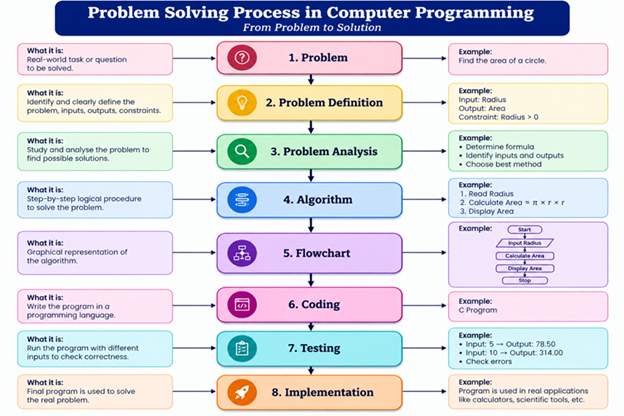
- What are the steps in problem solving?
- Problem Definition
- Problem Analysis
- Algorithm
- Flowchart
- Coding
- Testing
- Implementation
Multiple Choice Questions (MCQs)
- Problem Definition is the ______ step in program development.
- A) Second
- B) First
- C) Third
- D) Last
Answer: B
- Which of the following is identified during Problem Definition?
- A) Input
- B) Output
- C) Constraints
- D) All of the above
Correct Answer: D
- Which diagram graphically represents a solution?
- A) Algorithm
- B) Flowchart
- C) Compiler
- D) Interpreter
Answer: B
- Which programming language is commonly used to implement algorithms?
- A) C
- B) Java
- C) Python
- D) All of the above
Correct Answer: D
Frequently Asked Questions (FAQs)
What is Problem Definition in C Programming?
Problem Definition is the process of understanding and clearly defining the problem before writing a C program.
What is the difference between Problem Definition and Algorithm?
Problem Definition explains what needs to be solved, while an Algorithm explains how the problem will be solved.
Why is Problem Analysis necessary?
It helps determine the most efficient method to solve a problem.
What comes after Problem Definition?
Problem Analysis, followed by Algorithm Design, Flowchart, Coding, Testing, and Implementation.
Summary
Problem Definition is the foundation of successful software development. It helps programmers clearly understand the problem, identify inputs and outputs, analyse requirements, and prepare an effective solution. A well-defined problem leads to efficient algorithms, error-free coding, and reliable software. Every programming project, regardless of its size, should begin with a clear and detailed problem definition.
Some More:
POP- Introduction to Programming Using ‘C’
OOP – Object Oriented Programming
DBMS – Database Management System
RDBMS – Relational Database Management System
Join Now: Data Warehousing and Data Mining